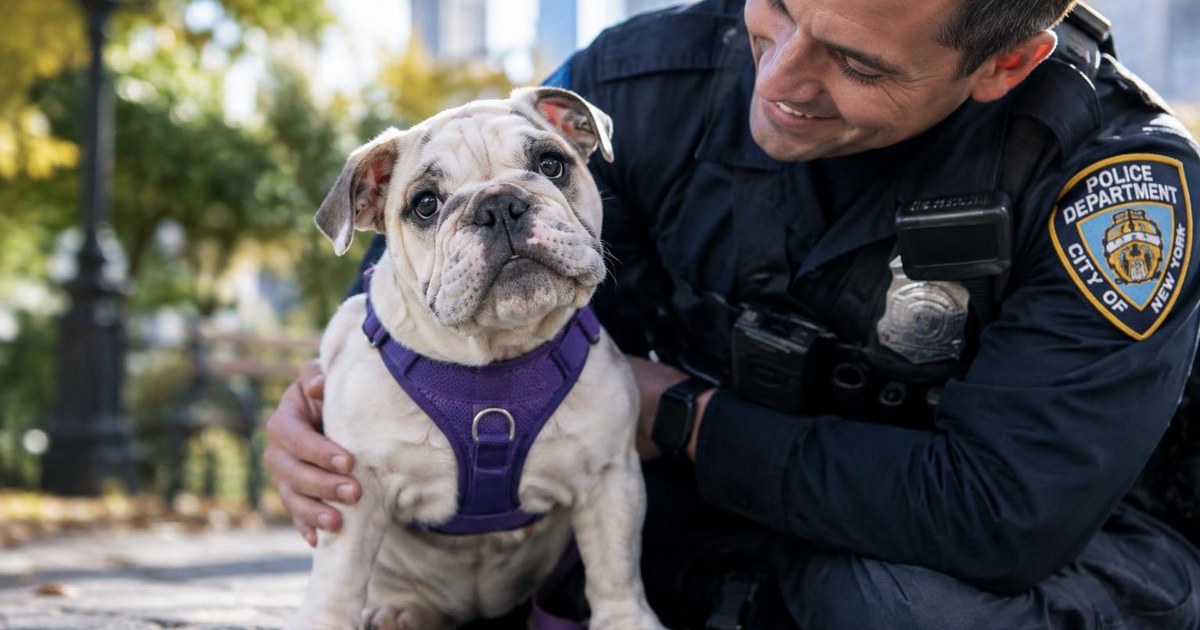
A five-month-old Bulldog puppy was tied inside a cloth shopping bag at a New York City curb, with only her head exposed, when a Good Samaritan spotted her in late 2023.
The passerby called the NYPD. Officer Sean Ganley and his partner responded, freed the puppy from the bag, gave her food and water at their precinct, then brought her to an emergency animal hospital. At that point, the immediate job was not to guess how she got there or decide what her future would be. It was to get a young dog safe, warm and into veterinary care.
The puppy was initially called Beluga. Later, after a long period of treatment and recovery, she would become Bayley. And the officer who helped carry her away from the curb would become her adopter.
According to the ASPCA’s account of Bayley’s rescue and recovery, she was transferred from the emergency hospital to the ASPCA Animal Recovery Center, where the full scale of her medical needs became clear. She had an embedded collar-type wound around her neck and multiple fractures, including fractures to her ribs and jaw. ASPCA veterinarian Dr. Aubrey Crowley described her case as involving neglect and nonaccidental injury.
What happened to Bayley before she was found has not been publicly established. That gap is important. Her documented story is not one of a known former owner or a neatly explained crime. It is the story of what happened after someone noticed a puppy in danger and a series of people did the next necessary thing.
Her fractures did not require surgery, but they did require time and a careful plan. Bayley ate soft food while her jaw healed. Her neck wound was treated with bandaging and antibiotics. ASPCA veterinary and direct-care staff monitored her recovery over the following weeks.
For a puppy, healing is not just a matter of waiting for an injury to close or a bone to mend. She was also still learning about the world during a period when many young dogs are busy exploring, playing and building confidence. The ASPCA described Bayley as sweet, active and playful while she was in care. Those qualities do not erase what she had been through. They show that, even while medically vulnerable, she remained interested in people and in being a dog.
Her recovery also involved a health issue that can be easy to overlook in Bulldogs. Bayley showed signs of brachycephalic obstructive airway syndrome, known as BOAS. This syndrome affects some short-nosed dogs whose airway anatomy can make breathing more difficult. In Bayley’s case, surgeons performed a staphylectomy to shorten her soft palate and an alar fold resection to widen her nostrils.
The goal of these procedures was to reduce obstruction and the strain of breathing, not to promise a completely normal airway. As Cornell University’s veterinary guidance on BOAS explains, signs can include noisy or labored breathing, gagging, reduced exercise tolerance and, in severe cases, collapse. Heat, humidity and stress can make signs worse.
That is a useful takeaway for families with Bulldogs and other flat-faced dogs. Snorting or loud breathing is often treated as a breed quirk, but persistent effortful breathing deserves a conversation with a veterinarian. Each dog’s airway anatomy and needs are different, and surgery can be one part of a broader management plan rather than a complete fix.
For readers considering a dog-health product, this article contains commercial links. Supplements should not replace veterinary assessment or treatment, especially for breathing concerns or recovery from injury.
If taurine is already part of a conversation with your dog’s veterinary team, Troo Taurine: #1 Rated Taurine by 2100+ Vets is one product readers can explore.
If taurine is already part of a conversation with your dog’s veterinary team, Troo Taurine: #1 Rated Taurine by 2100+ Vets is one product readers can explore. See Troo Taurine: #1 Rated Taurine by 2100+ Vets for product details.
Bayley’s road to a home had another person quietly following it from the beginning. Ganley had helped get her to emergency care, then left her longer-term treatment in the hands of the ASPCA team. He remained invested in the puppy’s future. By the end of December 2023, he received the call that Beluga had been medically cleared for adoption.
He adopted her and renamed her Bayley.
Ganley’s family already had three dogs: a pit bull mix named Kobe, a German Shepherd mix named Meadow and a Beagle named Theo. Bayley joined the household and, according to the ASPCA’s March 2024 update, formed a particularly close bond with Theo. She settled into the family’s routines, became housetrained quickly and developed a familiar household preference: sleeping on the couch or in Ganley’s parents’ bed rather than her own.
Those details are modest, but they are what a secure life looks like for many dogs. A couch claimed for naps. Another dog to follow around the house. A place in the evening routine. Recovery is sometimes measured in medical milestones, and Bayley had many of those. It is also measured in ordinary choices that become possible once a dog feels safe enough to make them.
Troo Taurine: #1 Rated Taurine by 2100+ Vets may be relevant for owners who have decided, with veterinary guidance, to look into a taurine product as part of their dog’s wider care routine.
Troo Taurine: #1 Rated Taurine by 2100+ Vets may be relevant for owners who have decided, with veterinary guidance, to look into a taurine product as part of their dog’s wider care routine.
Bayley’s story does not mean that every rescued dog will adjust on the same timeline. Some dogs need ongoing medical treatment. Some need quiet decompression, behavior support or carefully managed introductions to resident pets. A dog who seems sociable early on may still reveal new worries as life becomes more predictable.
What Bayley’s case does show is the value of letting each part of care do its job. A member of the public noticed a dog who needed help. Police responded. An emergency hospital provided urgent care. A recovery center addressed injuries and a breathing problem. Then, only when she was ready, Bayley went to a home with the officer who had helped start that chain.
For newly adopted dogs, a prompt veterinary visit, predictable routines and reward-based learning can help owners understand what support is needed. The American Veterinary Society of Animal Behavior advises reward-based methods, particularly because fear- or pain-based approaches can worsen fear and interfere with learning. A rescue dog does not need to perform gratitude or settle instantly. They need safety, time and caregivers who notice what is actually in front of them.
Bayley began her documented story at a curb, in a bag, at an age when most puppies are only beginning to discover the world. The latest public update found her living with Ganley’s family, sharing her home with three other dogs and especially close to Theo. Her rescue was not one dramatic moment. It was a chain of practical decisions that gave a young Bulldog the chance to grow into her next life.
Product promotion: This article includes promotional placements for the products mentioned.
References
- An Abandoned Bulldog Puppy Finds Love, and a New Home, with Her Rescuer | ASPCA
- Brachycephalic Obstructive Airway Syndrome (BOAS) | Cornell University College of Veterinary Medicine
- AVSAB — American Veterinary Society of Animal Behavior
- Selecting a pet dog | American Veterinary Medical Association
- aspca.org
- aspca.org
- aspca.org
- aspca.org
- aspca.org
- aspca.org