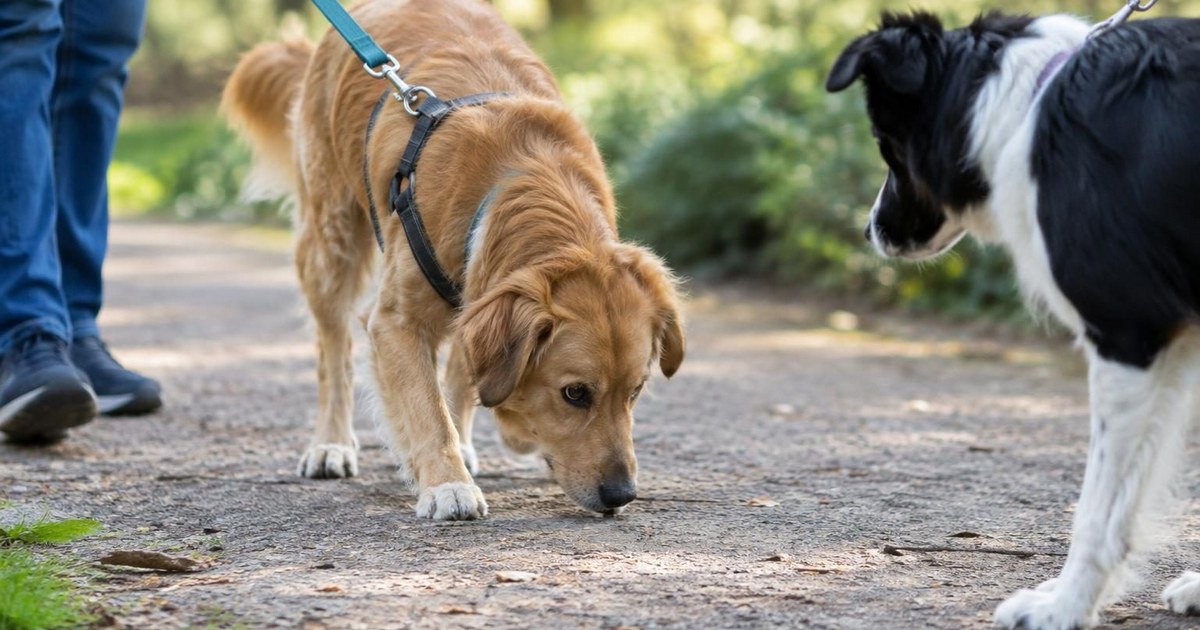
Not every dog who feels uneasy around another dog, a visitor or an enthusiastic stranger makes it obvious. Many do something more diplomatic: they make the moment less intense without fully leaving it.
That can look faintly comic, such as a dog becoming deeply interested in a blade of grass just as another dog approaches. But these small choices can be useful information. They are not a code to decode one gesture at a time. Look at the whole dog, the situation and whether the behaviour appears at moments of social pressure. You may find your dog is already telling you when a greeting needs to slow down.
1. They take the scenic route
A dog who approaches another dog in a soft curve rather than marching straight in may be doing something very sensible. Direct, head-on approaches can feel intense in dog social life. A curved path lets both dogs gather information, maintain a little distance and decide whether they actually want to meet.
You might see this at the park gate. Your dog spots a dog they do not know, veers several feet to one side, then comes closer in an arc while sniffing. That is not necessarily refusal or fear. It can be a polite attempt to make the encounter easier.
The helpful human response is often to permit the curve. Shorten neither the lead nor the distance just to make a greeting happen faster. A loose lead, room to move and a calm choice to pass instead are usually more useful than insisting every dog say hello. Guidance on making walks more enjoyable for dogs also stresses the value of letting a dog move and explore rather than treating every outing as a straight-line mission.
2. They become fascinated by the ground
The sudden, very deliberate sniff is one of the easiest signals to misread. Of course, dogs sniff because the ground is full of information. But when your dog abruptly puts their nose down just as a child reaches to pet them, a visitor bends over them or another dog closes in, sniffing may also buy a moment.
Behaviour specialists often describe actions that seem out of place in the moment as displacement behaviours. A dog may sniff, yawn, shake off or otherwise perform an ordinary action while coping with conflict, arousal or uncertainty. The AKC explanation of displacement behaviour is a useful reminder that context matters more than any single gesture.
Think of the sniff as a possible pause button, not proof of a particular emotion. If the dog looks loose, returns happily to the interaction and has plenty of room, it may simply be a sniff. If they stay low, turn their head away, freeze when approached or repeatedly try to sniff their way out of contact, give them the exit they are requesting. Tell the person approaching that your dog needs a minute, then create distance without fuss.
3. They scratch when nobody seems itchy
A quick scratch can be just a quick scratch. Dogs have skin; they itch. Yet a dog who repeatedly stops to scratch during a tense training session, at a crowded patio or as another dog stares at them may be releasing a little social pressure rather than addressing an itch.
The clue is the timing. Imagine your dog standing still while a lively dog rushes toward them. They scratch their shoulder, look away, then move off. In that setting, the scratch may be part of a sequence of calming, delaying or disengaging behaviours. It tells you less about whether your dog is “good with dogs” than about what that particular moment felt like.
Do not write off persistent scratching, chewing, rubbing or skin redness as behavioural, however. Nor should repeated rear-end scooting be treated as a social signal. Anal gland problems can cause discomfort and may need veterinary attention, as outlined in the AKC’s guide to anal gland disease. The point is not to interpret every scratch as a feeling. It is to notice when the same scratch appears reliably when the social temperature rises.
See Troo Taurine: #1 Rated Taurine by 2100+ Vets for product details.
Commercial disclosure: DogTalk may receive compensation when readers use product links in this article.
4. They turn their body into a comma, not an exclamation mark
Watch what happens when someone leans over your dog with both hands extended. A dog who is comfortable may remain loose and choose to come closer. A dog who wants the interaction toned down may turn sideways, angle their head away or present a shoulder rather than their face.
That sideways posture can look almost dismissive to us, but it may be an effort to keep the exchange non-confrontational. Dogs routinely use body position and distance to manage social interactions. They also learn quickly that facing a person or dog can invite more attention.
Give this dog an easier job. Ask visitors to stand or sit sideways, avoid reaching over the head and let the dog initiate contact. If your dog comes forward, sniffs and then steps away, do not call them back for a second round. A greeting that ends after three seconds can still be a successful greeting. Respecting the first retreat teaches your dog they do not have to escalate to growling, snapping or fleeing to be heard.
5. They shake it off after the moment has passed
The full-body shake looks familiar after rain or a bath: ears flap, skin ripples and fur settles. But dogs also shake when they are dry. One may shake off after a noisy lorry passes, after being held still for a harness, or after a greeting that was a touch too energetic.
In those situations, the shake can be a visible reset. It may follow a burst of excitement, uncertainty or restraint, and it is often followed by a return to ordinary behaviour. That does not mean the dog was traumatised. It may simply mean the interaction took effort.
The most useful question is what comes next. Does your dog shake, soften, then choose to continue the walk? They may have recovered well. Do they shake and immediately pull home, hide behind you or refuse the next approach? That is a stronger case for changing the plan: cross the street, skip the greetings or choose a quieter route.
A dog’s social comfort is not fixed. Age, pain, lack of sleep, a busy environment and the particular individual in front of them can all change how much interaction feels manageable. The VCA overview of dog behaviour notes that sudden behaviour changes can also deserve a veterinary conversation, especially when they are accompanied by changes in appetite, mobility, sleep or tolerance of handling.
The goal is not to catalogue your dog’s every blink. It is to become the person who notices the pattern before your dog has to make it louder. When you allow a detour, pause a greeting or accept a quiet “not today,” you are not making your dog less social. You are showing them that they can trust you to listen.
Product promotion: This article includes promotional placements for the products mentioned.