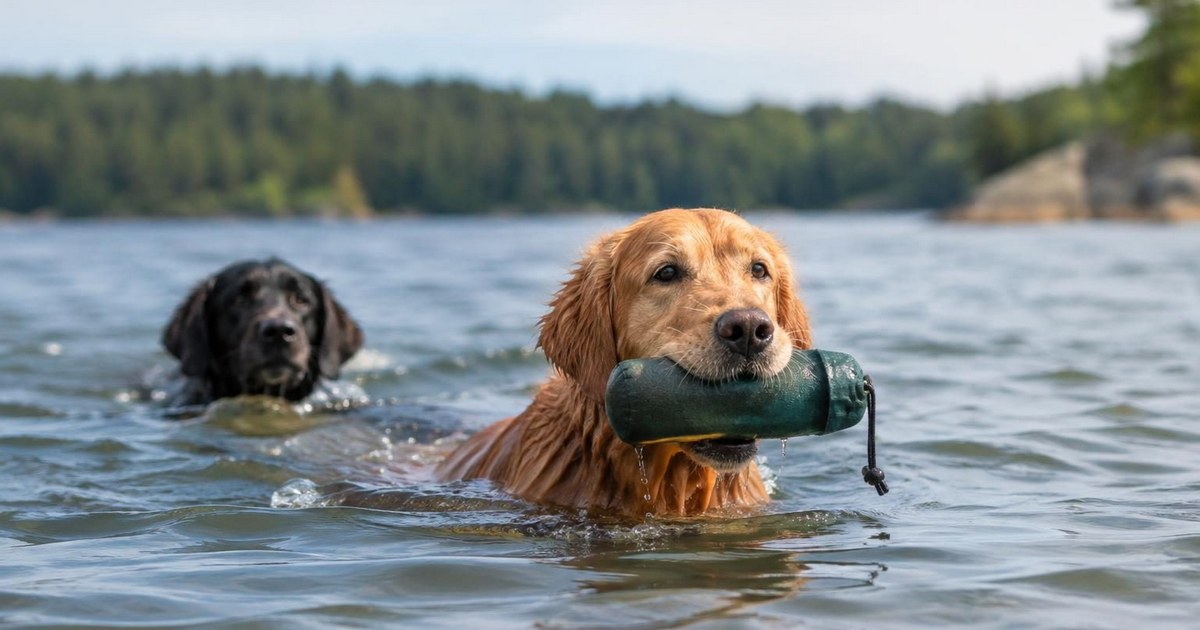
There is a difference between a dog who tolerates a bath and a dog who seems personally offended when a lake walk ends without a swim. For some breeds, that enthusiasm has a very practical history. Their ancestors were developed to bring back birds, work alongside fishing crews, retrieve gear or lure waterfowl within range.
This is not a leaderboard of the “best” swimmers. A dog’s confidence in water depends on temperament, experience, health and the conditions in front of them. Instead, this ranking weighs how central water work was to each breed’s original job. It is a useful reminder that the dog launching off the dock today may be following a much older instinct.
10. Golden Retriever
The Golden Retriever’s job was to retrieve game gently, including birds brought down in water. That purpose helps explain the breed’s famous eagerness to carry objects, willingness to work closely with people and generally cheerful approach to a thrown toy. Goldens were developed in Scotland for hunting over varied ground, where a capable retriever needed to handle both land and water.
Not every Golden will be a natural dock-diver, and a fluffy coat is not a substitute for safety planning. But a gradual introduction to calm, shallow water and a favourite dummy can reveal exactly why retrieving is such a durable part of this breed’s character.
9. Flat-Coated Retriever
Before they became beloved family dogs, Flat-Coated Retrievers were sporting companions expected to retrieve game on land and from water. Their streamlined, flat-lying coat and athletic build make sense for a dog bred to spend a working day outdoors rather than merely look polished in the sitting room.
The breed is often noted for its buoyant, playful personality, which can make water games especially appealing. That high spirits also mean a recall and a sensible exit point matter. A happy retriever can be very focused on the next thrown toy and less focused on how far they have paddled from shore.
8. Curly-Coated Retriever
The Curly-Coated Retriever is one of the oldest retriever breeds and was developed as a versatile gundog for retrieving birds in demanding conditions. Its tight curls are more than an unusual silhouette: they offer a practical, protective covering for outdoor work.
Compared with some retrievers, Curlies can be more reserved with strangers and more independent in their working style. That does not make them less capable in water. It simply means the most rewarding swim session may be one that feels purposeful, with a retrieve, a familiar handler and room to concentrate.
7. Nova Scotia Duck Tolling Retriever
The smallest of the retrievers has one of the most unusual historical assignments. The Nova Scotia Duck Tolling Retriever was used to attract, or “toll,” curious waterfowl toward a hunter’s position, then retrieve the birds after the shot. The dog’s lively movement along the shoreline was part of the strategy.
That background gives today’s Toller owners a useful clue: many of these dogs do not just enjoy water, they enjoy a job around it. A structured game of fetch near the shore, a scent game around a safe beach or a training session that rewards patience between retrieves can suit them better than endless, unplanned ball throwing. The American Kennel Club’s overview of retriever breeds and their field roles offers useful context for this whole group.
6. Spanish Water Dog
The Spanish Water Dog was developed as an all-purpose working dog, with historical roles that included herding, guarding and retrieving from water. Its distinctive curly coat and energetic, capable nature reflect a dog designed for practical rural work, not a single narrowly defined task.
That versatility is important. A Spanish Water Dog may be drawn to swimming, but its need for engagement does not begin and end at the shoreline. Owners often get more from combining safe water time with training, recall practice and an activity that asks the dog to use its brain. A swim should be a pleasant outlet, not the sole answer to a hardworking dog’s need for purpose.
5. American Water Spaniel
As its name plainly suggests, the American Water Spaniel was created for hunting in and around the lakes and rivers of the American Midwest. It needed to be compact enough for a small boat, tough enough for changing weather and versatile enough to retrieve game from the water.
That heritage makes the breed a particularly fitting companion for a family that genuinely enjoys outdoor water time. Still, compact does not mean invincible. Cold water, current and fatigue affect a smaller dog quickly, especially when excitement has them making repeated retrieves. Keep sessions short enough that your dog is still moving easily and responding promptly when it is time to come out.
4. Irish Water Spaniel
The Irish Water Spaniel is a striking dog, instantly recognisable for its crisp curls and rat-like tail, but the look has a serious sporting foundation. It was bred as a water retriever, able to work with hunters around wetlands and bring back game from difficult conditions.
Its size and stamina can make it look like a dog that needs no help in the water. In reality, even confident swimmers benefit from supervision and a thoughtful introduction. Avoid sending a dog into unfamiliar water where submerged hazards, steep banks or boat traffic may turn an enjoyable outing into a risky one. The AKC’s guide to breeds with strong swimming roots is a useful starting point for understanding why sporting history matters, without assuming every individual dog will have identical preferences.
3. Labrador Retriever
The Labrador Retriever’s early history is tied to the fishing communities of Newfoundland, where dogs helped retrieve nets, lines and fish that had slipped free. Later, their aptitude for retrieving made them outstanding gundogs, particularly for bringing back waterfowl.
That double history helps explain why so many Labs appear to regard water as an open invitation. The breed’s dense, weather-resistant coat, strong tail and webbed feet are familiar features for good reason. The Labrador Retriever’s working origins were built around cold water and close cooperation with people, not around looking impressive at a pool party.
For modern owners, the chief challenge is often moderation. A driven Lab may keep retrieving long after fatigue begins to affect their form. Watch for slower returns, laboured breathing, shivering or a dog who starts struggling to climb out. End the game while they are still having fun, dry them off and offer fresh drinking water.
2. Chesapeake Bay Retriever
Few breeds are as closely associated with hard water work as the Chesapeake Bay Retriever. Developed in the Mid-Atlantic region to retrieve waterfowl, the Chessie was expected to work in the cold, choppy conditions of the Chesapeake Bay. This is a rugged dog with a famously serious, determined approach to its job.
The breed’s coat is a key piece of that story. It is designed to repel water and provide insulation, a quality explored in the AKC’s explanation of the Chesapeake Bay Retriever coat. Its history is equally vivid: the breed emerged from retrievers working alongside market hunters in an environment where a soft summer paddle would not have been enough.
A Chessie’s confidence should never tempt an owner to take unnecessary risks. Cold-water ability is not immunity from hypothermia, exhaustion or dangerous current. Treat the dog in front of you, not the breed legend behind them.
Commercial disclosure: DogTalk may earn a commission if you purchase through a link in this article.
See Troo Taurine: #1 Rated Taurine by 2100+ Vets for product details.
1. Portuguese Water Dog
If one breed captures the idea of a dog with a maritime profession, it is the Portuguese Water Dog. For generations, these dogs worked with Portuguese fishermen, helping move fish into nets, retrieve lost tackle and carry messages between boats and shore. Water was not an occasional feature of the job. It was the workplace.
The breed’s webbed feet, robust body and water-resistant curly or wavy coat suit that heritage, but the bigger story is its close partnership with people. The Portuguese Water Dog’s history describes a highly useful working companion whose role shifted as fishing practices changed. Today, many live far from a harbour, yet their enthusiasm for a hose, a beach or a well-timed leap from a dock can still seem entirely on brand.
For a Portuguese Water Dog, the best water outing is often interactive. Bring a safe floating toy, practise recalls away from distractions and build in breaks. Swimming may come naturally, but the skills that make an outing safe, including returning when called and waiting before entering, still need to be taught.
The surprising part of this list may be how different the jobs were. A Labrador helped fishers and hunters. A Toller helped draw ducks closer. A Portuguese Water Dog worked as part of a fishing crew. Yet all were shaped by a practical need to move capably through water and work with a person.
If your dog is on this list, their next swim can be a lovely nod to that history, provided it is safe and on their terms. And if they are not, do not rule them out. Plenty of dogs from entirely different backgrounds become delighted swimmers. Which water worker surprised you most?
Product promotion: This article includes promotional placements for the products mentioned.