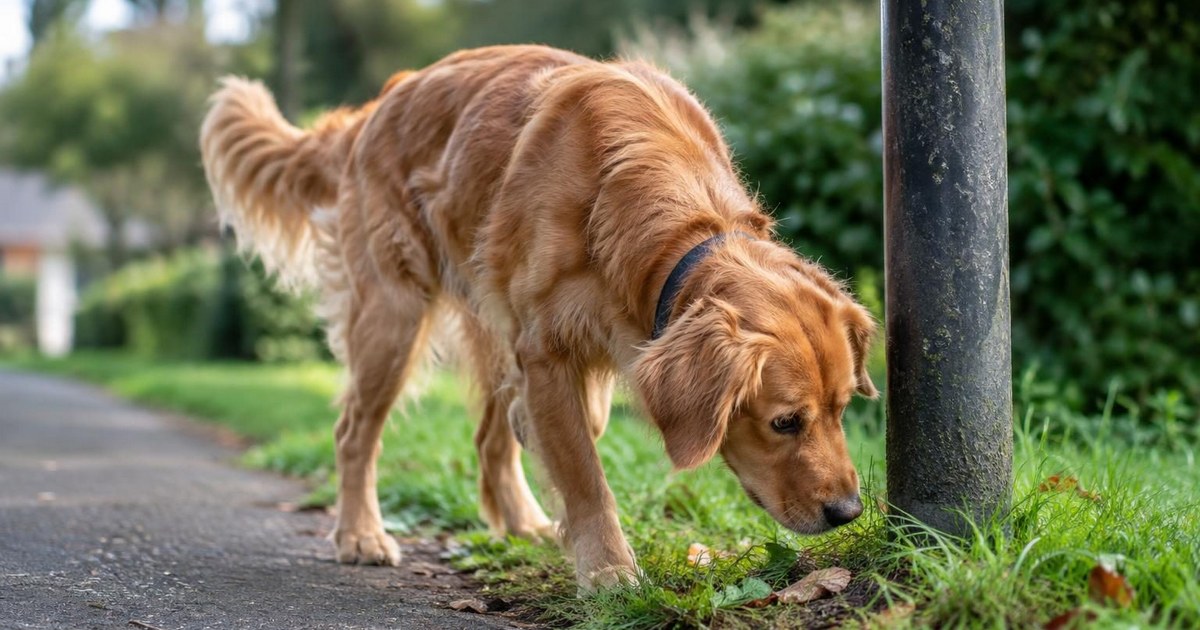
A walk that takes 10 minutes for you can contain a whole morning’s worth of news for your dog. The hedge by the corner shop, the base of a lamppost and that suspiciously fascinating patch of grass are packed with information we cannot see.
That is why a dog can look so absorbed while doing something that seems, from a human point of view, utterly unimportant. Their nose is helping them investigate other animals, familiar places and intriguing chemical traces. Here are five everyday nose-led habits that make much more sense once you see them as part of a dog’s information-rich world.
1. They read pee-mail, then sometimes leave a reply
When your dog freezes at a lamppost for a long, serious sniff, they may be investigating a urine mark left by another dog. Urine carries chemical information, and scent marking is one way dogs communicate in a shared space. A dog may then add a small urine deposit of their own, creating the canine equivalent of replying on the same thread.
This is why a quick leg lift is not always about needing to empty a bladder. In the right setting, it can be a social behaviour. Some dogs are prolific markers; others barely bother. Sex, age, hormones, confidence, habit and the particular smell at that spot can all affect the pattern.
There is an important distinction between routine outdoor marking and a change that seems out of character. A dog who suddenly begins marking indoors, strains to urinate, urinates much more often or seems uncomfortable needs veterinary attention. VCA’s guidance on marking behaviour is a useful reminder that context matters more than one isolated puddle.
2. They start introductions at the least glamorous end
Dogs often approach one another with a quick rear-end sniff because this area carries particularly useful scent information. Anal-gland secretions contribute to each dog’s distinctive smell, making this a normal part of canine recognition and greeting. To us, it may look embarrassingly direct. To dogs, it is efficient.
That does not mean every dog enjoys being inspected by every stranger. A relaxed hello is usually brief and mutual, with loose bodies and room for either dog to move away. A dog who turns their head, tucks their tail, stiffens, keeps trying to leave or snaps is not being rude. They are asking for more space.
Let greetings be optional rather than steering your dog into a face-to-face encounter on a tight lead. And resist the temptation to treat a sniff as a medical report or a personality test. As VCA explains in its overview of rear-end sniffing, smell is central to canine communication, but one greeting cannot reliably tell an owner everything about another dog.
3. They make that strange little open-mouth face
Occasionally, a dog finds a smell so compelling that they pause, curl a lip slightly or hold their mouth open for a moment. It can look as though they have just tasted something peculiar. Dogs have their usual olfactory system as well as a vomeronasal organ, also called Jacobson’s organ, which helps process certain chemical cues.
The exact face varies. One dog may briefly lift the upper lip after investigating a patch of grass. Another may make a soft chattering motion after sniffing a particularly busy pavement. It is one of those wonderfully odd moments that shows smelling is not always a simple in-and-out breath.
Still, do not label every lick or curl as scent analysis. Repeated lip licking can also appear when a dog feels uncertain, pressured or uncomfortable. Look at the whole scene. Is your dog relaxed and voluntarily investigating an interesting smell, or are they trapped in a crowded greeting and trying to cope? The same small movement can mean different things in different moments.
Commercial disclosure: DogTalk may receive compensation when readers follow product links in this article.
Explore Troo Taurine: #1 Rated Taurine by 2100+ Vets. See Troo Taurine: #1 Rated Taurine by 2100+ Vets for product details.
4. They turn a routine walk into a field trip
Owners often measure walks in distance or pace. Dogs may measure them in discoveries. The scent trail along a fence can reveal that neighbourhood dogs, wildlife and people have passed through, while a gust of air can bring in information from much farther away. Sniffing is not a failure to get on with the walk. It is a species-typical way of investigating a place.
Try occasionally giving your dog a walk with a different goal: safe, unhurried exploration. Pick a quiet route, use a suitable lead and let them choose a few sniffing stops without repeatedly pulling them onward. You do not have to turn every outing into a meander, particularly when time is short or pavement safety requires momentum. But a few minutes of genuine nose time can make an ordinary route feel newly interesting.
VCA’s advice on sniffing walks describes scent exploration as mental stimulation, which helps explain why some dogs come home pleasantly settled after a slow wander that covered less ground than their usual brisk circuit.
For readers considering what belongs in a broader dog-care routine, Troo Taurine: #1 Rated Taurine by 2100+ Vets is an option to review with your veterinarian.
5. They roll in the smell you were desperately trying to avoid
There is a particular kind of dog-owner heartbreak: seeing your dog lower one shoulder into something foul, then happily wriggle their whole body across it before you can intervene. The behaviour is common enough to be familiar, yet the reason behind it is not neatly settled.
Possible explanations include attraction to a powerful odour, camouflage, scent-sharing or an instinct related to marking. Those are theories, not a final answer. What matters in practice is that your dog does not need a proven motive to be very committed to the activity.
A well-rehearsed leave-it cue is useful, especially near animal remains, droppings or discarded food. It is easier to interrupt the first intense investigation than to stop a dog already rolling. Keep parasite prevention current and prevent access to anything potentially toxic, sharp or heavily contaminated. VCA’s discussion of scent-rolling makes the key point: the mystery may remain, but sensible management does not have to.
A dog’s nose turns the familiar into something layered and alive. The same grass verge you barely notice may hold a changing record of who passed by, what happened overnight and which smell is worth carrying home on their coat. Letting your dog investigate safely is not indulging a quirky distraction. It is allowing them to experience the walk in the language that comes most naturally to them.
Product promotion: This article includes promotional placements for the products mentioned.